
Terminal blocks create repeatable, serviceable connection points between field wiring and internal panel circuits. The category includes general-purpose feed-through blocks as well as specialized ground, fuse-holder, disconnect and spring-clamp designs.
Choosing a terminal block requires matching conductor size and type, current, voltage, insulation requirements, connection method, mounting rail and circuit function. Accessories such as jumpers, markers, end stops and partitions are part of the system and should be planned with the blocks.
A complete terminal-strip design also accounts for jumpers, identification, test access, protective earth, future service and the physical space needed for conductor routing.
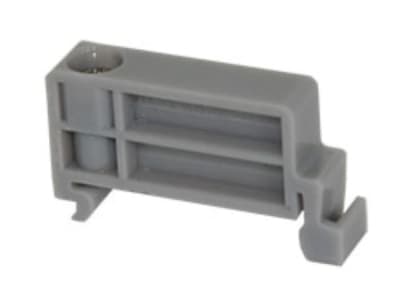


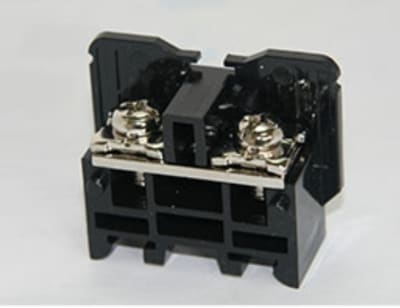


In a control panel, terminal blocks form the interface between field devices and internal control wiring. They make circuits easier to assemble, identify, test, isolate and service than direct splices. Feed-through blocks connect one conductor to another; multi-level blocks increase wiring density; ground blocks bond protective conductors to the mounting rail or grounding system; fuse and disconnect blocks add circuit functions directly at the termination point.
A well-designed terminal strip also improves troubleshooting. Wire markers, block markers and consistent terminal numbering allow technicians to trace a circuit from a drawing to the physical panel without disturbing unrelated conductors.
Start with the conductor range and verify whether the terminal accepts solid, stranded or fine-stranded wire and whether ferrules are required or recommended. Current-carrying capability depends on conductor size, terminal design and applicable ratings. Voltage rating and required spacing also matter, especially when adjacent circuits operate at different potentials.
Do not size a block only from the load current printed on a schematic. Consider branch-circuit protection, available fault current, field conductor size and any applicable panel or equipment standards. For higher-current circuits, verify tightening torque and use conductors and lugs compatible with the terminal's listing or instructions.
Screw-clamp terminals use a screw-driven clamp or pressure plate and remain widely used in industrial panels. They provide familiar installation and can accommodate a broad conductor range, but correct torque is important. Spring-clamp or push-in designs use spring force to maintain conductor pressure and can reduce installation time, particularly where vibration or high wiring density is a concern.
The best connection technology depends on the maintenance philosophy and conductor type. Fine-stranded conductors may benefit from properly crimped ferrules. Mixing connection methods within a terminal strip is possible when the product family provides compatible accessories, but jumpers and markers must match the specific series.
Ground terminal blocks provide an identifiable protective-earth connection and often make electrical contact to a conductive DIN rail. Fuse-holder terminal blocks place replaceable overcurrent protection directly at the termination point and may include indication. Disconnect or knife-disconnect blocks allow a circuit to be opened for testing or service without removing conductors.
These functions are not interchangeable. A ground block should be used only in the manner intended for protective or functional grounding; a fuse block must match the fuse class, size and electrical ratings; and a disconnect block's open state should provide the isolation required by the test procedure.
Terminal strips normally require more than the blocks themselves. Common accessories include end plates, end stops, DIN rail, cross-connect jumpers, test plugs, separators, marker strips and identification tags. Plan the strip as a system so jumpers carry the required current, partitions preserve spacing, and markers remain readable after wiring is complete.
Leave appropriate spare terminals and physical space when future expansion is likely. Good terminal-strip layout separates different voltage classes or functions where required and keeps field wiring accessible without forcing conductors over components that may need replacement.
Should terminal blocks be sized to wire or load? Both. The block must accept the actual conductor and carry the circuit current at the required voltage, while also fitting the panel's insulation, spacing and fault-current requirements. A large wire that physically fits is not proof that the connection is correctly rated.
When are ferrules useful? Ferrules organize fine strands and can make insertion into spring or push-in terminals easier. They must be correctly sized and crimped, and the terminal must be rated for ferruled conductors. Ferrules should not be used to force an oversized conductor into a smaller terminal.
Why stay within one terminal family? Jumpers, markers, end plates, test plugs and partitions are typically designed around a specific terminal pitch and housing geometry. Standardizing a strip on one compatible family reduces parts complexity and avoids improvised cross-connections.