
Video baluns allow compatible surveillance video signals to travel over twisted-pair cabling instead of traditional coax. They are widely used in CCTV retrofit and structured-cabling environments where Category cable is already available. Balun selection depends on the video format, cable type, distance and whether the transmitter/receiver is passive or active.
Match the balun to the exact video technology and required distance. Check supported CVBS/HD-TVI/HDCVI/AHD formats, resolution, passive or active design, connector type, surge protection and whether one or both ends require power.
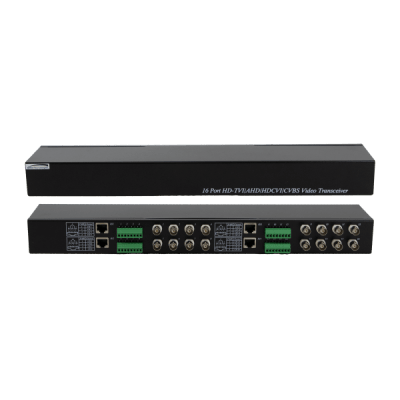


A balun adapts an unbalanced video connection such as 75-ohm coax to balanced twisted pair. A matching device at the far end converts the signal back. The concept is simple, but bandwidth requirements increase substantially for HD analog formats.
Passive baluns require no local power and are convenient for shorter runs. Active transmitter/receiver systems use amplification or equalization to support longer distances and challenging signals. Mixing active and passive components should follow the manufacturer’s specified topology.
Category-rated twisted pair with consistent impedance and good terminations improves performance. Avoid sharing pairs with incompatible signals unless the system is designed for it. Cable length, patch panels, splices and electromagnetic noise can all affect picture quality.
A balun designed for standard-definition composite video may not pass HD-TVI, HDCVI or AHD reliably. Select products that explicitly support the format and resolution being used rather than relying on connector compatibility.
Some accessories combine video with camera power or multiple channels over shared structured cabling. Check voltage drop and current capacity separately from video distance. Long power runs may become the limiting factor even when the video path is within range.
Rolling bars, color loss, ghosting or intermittent video can result from poor terminations, excessive distance, incompatible format, ground potential or induced noise. Test the camera locally on a known-good connection before assuming the balun itself has failed.
Baluns are useful when spare Category cable exists between camera and recorder locations, when coax pathways are unavailable, or when several analog channels can be consolidated into structured cabling. They are also used during temporary migrations where the final network architecture is not yet in place. The economic benefit comes from reusing cable—not from improving the underlying video signal.
Label which twisted pair carries each camera and keep pair assignments consistent at both ends. In multi-pair cables, avoid splitting a video circuit across conductors from different pairs. Document any patch panels or intermediate connections because additional connectors can affect high-frequency performance and become troubleshooting points later.
For a replacement or new installation, send Wallco the equipment model, system type, electrical or network requirements, installation environment and any compatibility constraints. The more application detail provided, the easier it is to narrow the correct product family and avoid a physically similar but incompatible part.
