
DC-DC DIN-Rail Power Supplies are used for conversion from one DC bus voltage to another. Important selection factors include input voltage range, output voltage, isolation, output current, efficiency, ripple, regulation, surge tolerance, grounding, rail mounting and approvals. Wallco organizes this category to help engineers, electricians, OEMs, facility teams and maintenance professionals compare products for battery systems, mobile equipment, transportation, industrial controls, renewable-energy systems, telecom, remote panels and mixed-voltage automation.
Unlike AC-input DIN-rail supplies, DC-DC models accept a DC source and may provide isolation, regulation or voltage conversion between control buses. Review the individual product specifications, wiring or connection requirements, environmental ratings and manufacturer instructions before selecting a unit for a specific application.


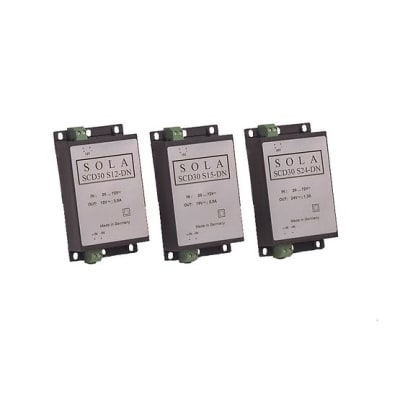

DC-DC DIN-Rail Power Supplies are used for conversion from one DC bus voltage to another. Selecting the right product starts with the electrical function, but the installation context is equally important. A model that matches voltage or power on paper may still be unsuitable because of phase, enclosure, topology, mounting, environmental rating, inrush behavior, connection method or applicable approvals. For that reason, Wallco organizes this category around the specifications that materially affect fit and performance rather than treating similar-looking products as interchangeable.
Before comparing part numbers, document the source power, required output, continuous load, expected transient or startup demand, ambient conditions, mounting location, available space and any code, listing or machine-standard requirements. That information narrows the field quickly and reduces the risk of selecting a product that is electrically close but operationally wrong.
For DC-DC DIN-rail power supplies, compare input voltage range, output voltage, isolation, output current, efficiency, ripple, regulation, surge tolerance, grounding, and rail mounting and approvals. These specifications work together. Capacity must cover the actual load, but oversizing does not correct a wrong voltage, phase, topology or environmental rating. Likewise, a product with the right nominal output may not be appropriate if its terminals, connector system, cooling method or mounting arrangement do not fit the equipment.
Pay particular attention to how manufacturers state ratings. Transformer capacity is normally expressed in VA or kVA, while UPS systems use both VA and watts and DC power supplies are commonly specified by volts, amps and watts. The usable capacity depends on the load and operating conditions, so compare the complete nameplate and datasheet rather than relying on one headline number.
DC-DC DIN-Rail Power Supplies are commonly used in battery systems, mobile equipment, transportation, industrial controls, renewable-energy systems, telecom, remote panels and mixed-voltage automation. The same category can serve very different installations, so application context matters. OEM machine builders may prioritize compact dimensions, terminal access and international approvals. Plant maintenance teams may place more value on direct replacement dimensions, ruggedness and quick availability. Facility engineers may focus on efficiency, heat, service access, bypass arrangements or long-term operating cost. The best selection is the one that fits the complete system requirement rather than the model with the largest rating.
Unlike AC-input DIN-rail supplies, DC-DC models accept a DC source and may provide isolation, regulation or voltage conversion between control buses. This distinction is important when navigating adjacent Wallco categories. Related products may share voltage or capacity ratings while solving a different problem. Transformers change AC voltage through magnetic coupling; regulated power supplies create controlled DC output; UPS systems maintain power during input disturbances or outages; and accessories support those systems without replacing their core function.
When a product legitimately fits more than one shopping path, Wallco may place it in multiple relevant categories. That helps customers approach the catalog by phase, construction, mounting style, topology or battery technology while preserving a clear primary product family.
Start with the actual connected load rather than the equipment name alone. For transformers and DC power supplies, include steady-state demand and any starting or inrush current. Coils, solenoids, contactors, motors, capacitive loads and electronic power supplies can draw substantially more current during startup than during normal operation. For UPS systems, compare both VA and watt requirements and include realistic runtime needs, future growth and any manufacturer restrictions on load type.
Margins should be intentional rather than arbitrary. Excessive oversizing can increase cost, footprint and sometimes no-load losses, while undersizing can lead to voltage drop, nuisance shutdown, overheating or shortened life. Where long cable runs are involved, account for conductor voltage drop independently from the source equipment rating.
Confirm nominal voltage is not the only requirement. Review allowable input range, frequency, phase, winding or output configuration, neutral requirements, grounding method and terminal arrangement. On transformers, primary and secondary taps can provide installation flexibility but must be connected correctly. On power supplies, verify whether the input is single-phase AC, three-phase AC or DC. On UPS systems, confirm input, output and bypass voltage/phase compatibility with the facility distribution.
Do not infer compatibility from connector shape or a familiar voltage label. A 24 VDC control supply, a nominal 24 V battery source and a 24 VAC transformer secondary are different electrical systems. Likewise, 208Y/120 V, 240 V delta and 480Y/277 V systems have different connection and neutral requirements even when equipment power ratings appear similar.
Installation environment can determine which construction is appropriate. Consider ambient temperature, dust, moisture, washdown exposure, ventilation, altitude, vibration, access for service and required ingress or enclosure rating. Ventilated equipment needs adequate airflow and clearance. Encapsulated or IP-rated products provide added environmental protection, but only when the published rating matches the actual installation.
Also verify mounting orientation, required clearances, conductor bending space, rack depth or rail space, depending on the product. Good thermal management matters because transformer insulation life, power-supply output capability, UPS battery life and electronic component reliability are all affected by temperature.
Compare built-in protective features with the needs of the system. Depending on the category, useful functions may include current limiting, short-circuit protection, overtemperature shutdown, surge protection, fuse provisions, electronic breakers, alarms, dry contacts, network communications, battery monitoring or maintenance bypass. These features do not eliminate the need for correctly coordinated upstream and downstream protection.
For critical applications, consider how the equipment will be maintained. Accessibility, replaceable batteries, plug-in modules, removable terminal blocks, front-service design and remote monitoring can significantly reduce downtime. A technically suitable product can still be a poor operational choice if routine service requires shutting down an entire process.
When replacing existing equipment, capture the complete old nameplate and installation details before searching by model number alone. Important information includes manufacturer and part number, input and output voltage, phase, VA/kVA or watt rating, enclosure or form factor, dimensions, terminal layout, frequency, approvals and any optional accessories. Obsolete products are often replaced by a current family with different dimensions or connection details even when the electrical rating is equivalent.
A cross-reference should therefore be treated as a starting point, not proof of drop-in interchangeability. Compare the current datasheet against the original installation and load requirements before ordering.
No. Voltage and capacity are essential, but phase, construction, topology, mounting, environment, connections, approvals and transient requirements can all determine whether the product is suitable.
Not automatically. Some margin is useful, but excessive oversizing can add cost and space without solving compatibility problems. Size from the real load and application requirements.
Yes. Many power products legitimately overlap by construction, phase, mounting style or technology. Multiple category assignments can improve navigation while the technical specifications remain the final basis for selection.
Have the complete existing model number and nameplate, input/output requirements, load, phase, physical dimensions, mounting, connection style and environment. Photos of the nameplate and installation are often helpful when the original part is obsolete.
Wallco works with industrial and commercial power-conversion and protection products across transformers, power supplies and UPS systems. If you are replacing an existing unit or sizing a new application, provide the source voltage and phase, required output, load, environment, mounting constraints and any known inrush or runtime requirements. Those details make it much easier to narrow the available products and identify the specifications that matter most.