
General-purpose terminal blocks provide a fixed, serviceable connection between conductors and are the foundation of many industrial terminal strips. Most applications use feed-through blocks to connect field wiring to internal panel circuits on a DIN rail.
Choose blocks by conductor range, rated current and voltage, connection technology, number of levels, mounting rail, terminal width and compatibility with jumpers, markers, end plates and other accessories.
Feed-through blocks are simple components, but terminal pitch, jumper compatibility, conductor preparation and clear marking strongly influence how serviceable the finished panel will be.
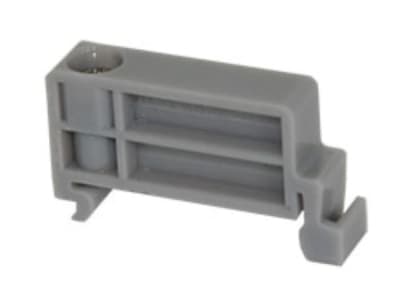



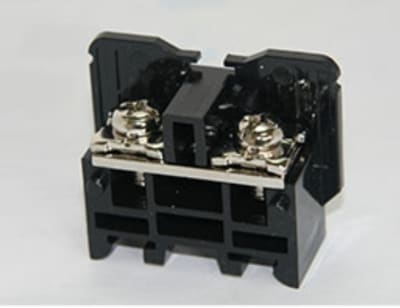


A feed-through terminal block electrically joins conductors on opposite sides of an insulated housing. Multiple blocks snap onto a DIN rail to create an organized terminal strip. This arrangement lets field wires terminate at a defined point instead of running deep into the panel, simplifying assembly, testing and future service.
Single-level blocks are straightforward and easy to identify. Multi-level blocks can increase wiring density where panel space is limited, but clear marking becomes even more important.
Verify the terminal's accepted wire range and whether ratings differ for solid, stranded and fine-stranded conductors. Screw-clamp terminals require the specified tightening torque. Spring-clamp or push-in styles use spring force and can speed installation. Fine-stranded conductors may require ferrules depending on the terminal design and local wiring practice.
Do not place more conductors under a connection point than the product is designed to accept. If multiple circuits need to be commoned, use the correct jumper or distribution accessory rather than improvised wire stacking.
Current rating should be compatible with conductor size and circuit load, while voltage rating must suit the insulation and spacing needed for the application. In mixed-voltage terminal strips, separators or additional spacing may be necessary. Also consider branch-circuit protection and any panel standards that affect component ratings.
For high-current blocks, correct conductor preparation and torque are essential because a loose connection can create heat even when load current is within the nominal rating.
Cross-connect jumpers distribute a common potential across adjacent blocks and should be rated for the current they will carry. End plates cover exposed sides of modular blocks, and end stops prevent the terminal strip from sliding on the DIN rail. Marker systems tie physical terminals to schematic identifiers.
Plan these accessories while selecting the blocks because terminal families use different jumper pitches and marker formats.
Group terminal blocks logically by machine function, cable, voltage class or I/O group. Leave enough wiring space for conductor bend radius and test access. Spare terminals can reduce future retrofit work. In panels that are serviced frequently, test points or disconnect blocks may be more appropriate than ordinary feed-through terminals for selected circuits.
Can two wires be placed in one terminal? Only when the terminal is specifically designed and rated for multiple conductors of those sizes and types. Otherwise use a multi-connection block or approved jumper/distribution method.
Why does terminal width matter? Width determines how much DIN-rail space a terminal strip consumes and also establishes jumper pitch. A few millimeters per block becomes significant across dozens or hundreds of circuits.
What spare capacity should be planned? There is no universal percentage, but leaving physical rail space and a reasonable number of spare terminals can dramatically simplify field changes. The right amount depends on machine lifecycle and likelihood of future I/O expansion.