
Shop industrial DC-DC converters used to convert one DC voltage level into another regulated DC output. These converters are commonly used in automation, transportation, battery-powered systems, telecommunications and industrial control applications where the available DC bus does not match the voltage required by the load.
Compare DC-DC converters by input-voltage range, output voltage, output current, wattage, isolation, efficiency, mounting method and environmental rating. Confirm that the converter can accommodate both normal source-voltage variation and the maximum connected load.


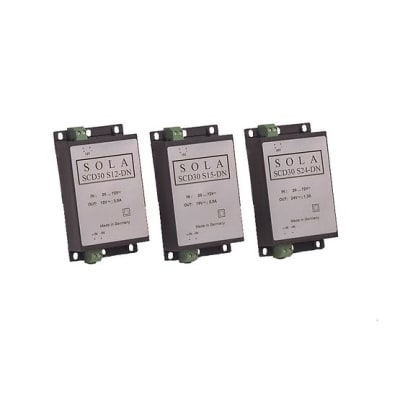

A DC-DC converter changes an available DC input voltage into the regulated DC voltage required by connected equipment. Depending on the design, the converter may step voltage down, step voltage up or provide electrical isolation between the input and output circuits.
Input voltage should be considered as a range rather than only a nominal value. Battery and industrial DC systems can vary significantly during charging, discharge or equipment operation, so the entire expected source-voltage range should remain within the converter specification.
DC-DC converters may be used to derive 24 VDC control power from a higher-voltage DC bus, supply lower-voltage electronics from a battery system or create an isolated DC supply for sensitive controls and communications equipment.