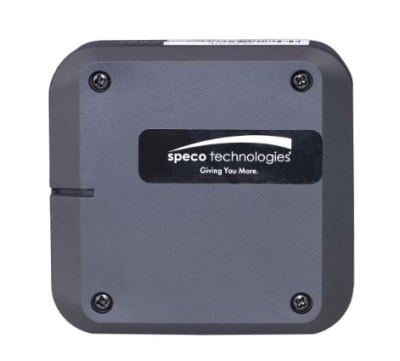
Access control controllers are the decision-making hardware between credential readers and door equipment. They evaluate credential data and programmed access rules, monitor door and request-to-exit inputs, operate locks through relay outputs and communicate events to management software. Controller architecture influences system scalability, resilience and serviceability.
Match the controller to door count, reader technology and software platform, then verify reader interfaces, input/output capacity, relay ratings, network communications, local event storage, offline operation, expansion options and power requirements.



A controller may manage one door, two doors or many openings through expansion boards. Count readers as well as doors because entry/exit reader configurations can require two readers per opening. Leave capacity for door contacts, request-to-exit devices and auxiliary inputs.
Wiegand remains common in installed systems, but it is largely one-way and offers limited supervision. OSDP uses RS-485 and can support bidirectional communications, device monitoring and Secure Channel encryption when both reader and controller implement it.
Good controllers continue to make access decisions locally if the host server or network connection is unavailable. Review how many credentials, schedules and events can be stored locally and what functions are lost during a communications outage.
Door contacts, REX devices, tamper switches and alarm inputs give the controller context. Relay outputs operate electric strikes, maglocks or interface relays. Confirm contact ratings and use external relays or power interfaces when lock current exceeds onboard output capability.
Controllers may communicate over Ethernet, RS-485 or proprietary buses. Consider address limits, panel-to-panel topology, network security, enclosure space and firmware management. Expansion should not require a complete redesign when a few additional doors are added.
Controller logic, readers and locks may share an enclosure but have different power requirements. Size the supply and standby batteries for worst-case lock operation and required backup time. Enclosures should provide space for wiring, batteries and service access.
Controllers are not generic substitutes simply because the wiring is similar. Confirm exact support in the intended access-control software, including licensing, firmware version and any required interface modules. For replacements, migration compatibility can be as important as raw hardware specifications.
A small site may favor compact controllers with onboard web management, while larger systems may use intelligent network controllers with downstream reader-interface modules. Distributed architecture can reduce field wiring and isolate failures, but increases the number of networked devices. Choose an architecture that the facility can support operationally, not just one that minimizes hardware count.
When an older access-control panel becomes obsolete, replacing the controller may affect readers, downstream modules, power enclosures and software licensing. Inventory the complete panel before specifying a successor. In some migrations, retaining compatible OSDP readers and field wiring can reduce cost; in others, proprietary buses or unsupported firmware make a broader replacement the more reliable path.
Controllers that supervise reader communication, door inputs and power conditions can provide better diagnostics than simple relay-only systems. Bidirectional reader protocols can report tamper, communication loss and device status, while monitored inputs can distinguish normal, alarm and trouble conditions. These capabilities improve maintenance because technicians can identify wiring or device faults before arriving on site. When evaluating a controller platform, review what conditions are actually supervised and how those alarms are presented to operators.
For a replacement or new installation, send Wallco the equipment model, system type, electrical or network requirements, installation environment and any compatibility constraints. The more application detail provided, the easier it is to narrow the correct product family and avoid a physically similar but incompatible part.