

FLIR and Extech cover complementary sides of professional inspection and measurement. FLIR is recognized for thermal imaging systems used to visualize temperature differences and identify abnormal heat patterns, while Extech supplies electrical, environmental, HVAC/R, mechanical and laboratory instruments used to quantify the conditions behind a problem.
FLIR handheld thermal cameras are used for electrical and mechanical inspection, predictive maintenance, building diagnostics and asset reliability. Depending on the series, important selection factors include thermal detector resolution, temperature measurement range, thermal sensitivity, lens field of view, focus method, image enhancement, reporting workflow and whether the application requires a compact imager, an advanced pistol-grip camera or a specialty solution for hazardous or hard-to-access environments.
Extech's test and measurement portfolio spans clamp meters, multimeters, insulation and ground resistance testers, power analyzers, bench power supplies, thermometers, humidity and moisture meters, airflow and air-quality instruments, light and sound meters, tachometers, force gauges, videoscopes, pressure meters and water-quality instruments. This breadth makes Extech especially useful when troubleshooting requires both electrical measurements and environmental or mechanical data.
For many maintenance and diagnostic tasks, thermal imaging and conventional measurements work together: a FLIR camera can locate a hot connection, overloaded component, heat-loss path or mechanical anomaly, while an Extech meter can help verify current, voltage, resistance, insulation condition, temperature, humidity, airflow or another measured parameter needed to diagnose the cause.


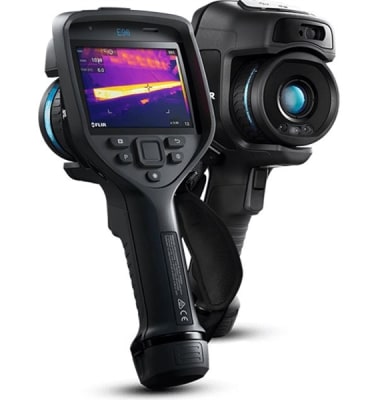


Start with the measurement problem, not simply the instrument name. For thermal imaging, identify the smallest target that must be resolved, expected target distance, temperature range, inspection environment and reporting requirements. Thermal resolution and lens field of view determine how much detail can be captured at a given distance, while sensitivity and measurement range affect how well the camera can distinguish and quantify temperature differences.
For electrical instruments, verify the measurement function, range, accuracy, CAT safety rating, conductor size, AC/DC capability and whether True RMS is required for non-sinusoidal loads. Clamp meters are useful for non-invasive current measurements; multimeters support direct voltage, resistance and other measurements; insulation testers and megohmmeters evaluate insulation resistance; and milliohm meters are used for very low resistance measurements where standard DMM resolution is insufficient.
Environmental and HVAC/R instruments should be selected by the actual variable being measured and the expected operating range. Airflow, temperature, humidity, pressure, air quality, moisture, sound and light measurements each require different sensor technologies and probe configurations, so application conditions can matter as much as headline accuracy.
Thermal imaging is valuable when the goal is to scan an area quickly and see temperature patterns across many components at once. A contact or electrical meter is often the next step when a technician needs to quantify a specific voltage, current, resistance, temperature or other parameter after the thermal scan identifies where to investigate.
Compare thermal resolution, temperature range, thermal sensitivity, lens options, focus, display and image-enhancement features, connectivity and reporting workflow. The correct combination depends on target size, inspection distance, required temperature accuracy and whether the work involves electrical, mechanical, building or specialty inspection.
The answer depends on what must be measured. Clamp meters are designed for current measurements without opening the circuit, multimeters provide broad electrical diagnostics, insulation testers evaluate insulation resistance, ground testers evaluate grounding systems, and power analyzers are used when load, power quality or energy behavior must be studied in greater detail.