Disconnect & Cam Switches
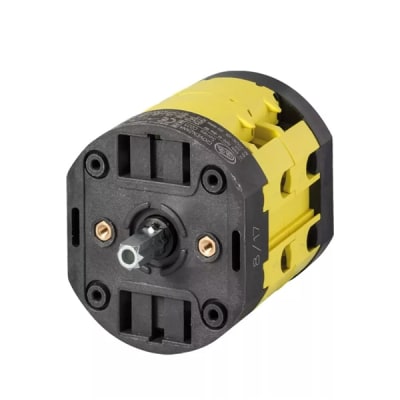
Shop industrial disconnect, cam and drum switches used for equipment isolation, on-off control, circuit selection and motor-direction control. These manually operated switches are commonly installed in machinery, control panels, maintenance disconnects, hoists and industrial motor applications.
Compare switches by current rating, number of poles, operating positions, switching sequence, mounting method, handle configuration and enclosure requirements. Verify the switch’s load rating and switching diagram for the intended application.
Selecting Disconnect, Cam and Drum Switches
Disconnect and rotary control switches provide manual switching for industrial equipment and electrical circuits. Depending on the design, a switch may isolate incoming power, select between operating modes, reverse a motor or control a specific sequence of contacts.
Similar-looking switches may have substantially different internal contact sequences. A replacement should be selected using the complete part number, switching diagram and application requirements rather than handle appearance alone.
Common Switch Types
- Disconnect switches: Provide a manually operated means of isolating equipment or circuits.
- Cam switches: Use stacked switching elements to provide specific contact sequences and operating positions.
- Drum switches: Commonly provide manual reversing or directional control for motors.
- Selector and changeover switches: Route circuits between multiple operating modes or power sources.
Important Selection Factors
- Application: Determine whether the switch provides isolation, on-off control, reversing or circuit selection.
- Voltage and current: Match the switch rating to the electrical load and duty type.
- Number of poles: Verify the number of circuits that must be switched simultaneously.
- Operating positions: Confirm the number and sequence of positions, such as forward-off-reverse.
- Switching diagram: Compare the internal contact sequence with the original switch or required circuit.
- Mounting method: Check panel, base, DIN-rail or enclosed mounting requirements.
- Handle and shaft: Confirm handle style, shaft length, door coupling and lockout requirements.
Replacement Checklist
- Manufacturer and complete switch part number
- Voltage, current and phase
- Number of poles and operating positions
- Required switching function or sequence
- Motor horsepower, when controlling a motor
- Mounting method, shaft and handle requirements
- Photographs of the switch, terminals and wiring diagram
Need help identifying a disconnect or cam switch? Email
[email protected] with the manufacturer, complete part number, voltage, current, phase, switching function and clear photographs of the switch, terminals and wiring diagram.