
Selector and control cam switches provide manual multi-position control by operating a defined sequence of contacts as the handle is rotated. Unlike a simple on/off switch, a cam switch can open and close multiple circuits in different combinations, making it useful for mode selection, control sequencing, motor functions and instrumentation.
Selection starts with the required number of handle positions and, more importantly, the contact sequence in each position. Two switches that both have three positions can perform completely different functions. Determine which terminals must be connected in each position, whether any positions are momentary or spring-return, and whether the operator must be key-operated, padlockable or otherwise restricted.
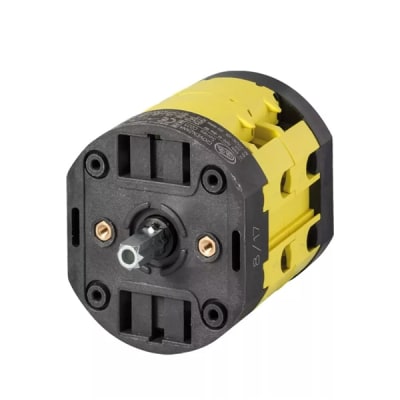
Selection starts with the required number of handle positions and, more importantly, the contact sequence in each position. Two switches that both have three positions can perform completely different functions. Determine which terminals must be connected in each position, whether any positions are momentary or spring-return, and whether the operator must be key-operated, padlockable or otherwise restricted.
Electrical ratings should be evaluated for the actual load type. Control-circuit switching, resistive loads and motor-related duty can have different requirements. Also verify panel cutout or mounting style, shaft length, front-plate legend, indexing angle and the number of contact stages needed to produce the required switching program.
Cam switches are common on control panels, machine tools, motor control centers, test equipment and process machinery. Typical functions include Hand-Off-Auto selection, Local-Remote selection, speed or mode selection, polarity changes, star-delta functions, motor direction selection and manual circuit sequencing.
The most common selection error is matching only the number of positions. A replacement must reproduce the original contact chart or switching program. If the old switch is no longer available, document every terminal and which contacts are closed in every handle position before removing it.
A cam switch is fundamentally a programmable mechanical contact sequence. That makes contact diagrams especially important during replacement. If an old switch is removed before its switching pattern is documented, reconstructing the machine logic can become difficult. Record the terminal numbers and continuity in every handle position, including any spring-return positions, so a replacement can be matched by function rather than appearance.
For a new design, a simple truth table is often the best specification: list each switch position and the contacts that must be closed in that position. That information can be mapped to the appropriate cam program much more reliably than a generic description such as “three-position selector.â€
The contact program. Match which terminals are connected in every handle position, then verify electrical ratings, indexing, shaft and mounting details.
A reliable selection comes from matching the device to the actual electrical system, load, environment and control function rather than choosing from a single headline rating. Record the existing manufacturer and part number when replacing equipment, and compare all relevant electrical, mechanical and environmental specifications before substituting another series.
Wallco supports industrial users, OEMs, integrators and maintenance teams that need help narrowing a replacement or choosing a component for a new panel or machine. Providing the application details up front helps identify the correct product family and avoids problems caused by physically similar but electrically different components.