
Surveillance camera lenses determine field of view, target size and how much light reaches the image sensor. On cameras that accept interchangeable lenses, focal length and sensor-format compatibility are fundamental design choices. The right lens can provide more useful detail than simply increasing camera resolution while keeping an overly wide view.
Confirm lens mount and sensor format first, then choose focal length from the required field of view and camera-to-target distance. Also check aperture, IR correction, resolution rating and whether manual, DC auto-iris or motorized control is required.
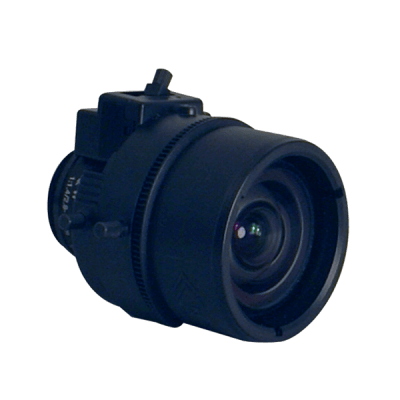
Shorter focal lengths produce wider views; longer focal lengths narrow the scene and enlarge distant targets. Selection should be based on the width of the area that must be seen at a known distance. A site plan is often more useful than choosing by focal length alone.
Fixed lenses are simple and economical when geometry is known. Varifocal lenses allow field-of-view adjustment during commissioning and are useful when mounting distance is uncertain. Motorized zoom lenses permit remote adjustment on compatible cameras.
The lens must cover the camera sensor without severe vignetting. A lens designed for a smaller sensor format may not fully illuminate a larger sensor. Resolution capability also matters as pixel density increases.
A larger aperture can admit more light but reduces depth of field. Auto-iris or P-iris functions help cameras manage changing outdoor illumination when both camera and lens support the control method. Verify connector and control compatibility.
Day/night cameras using near-infrared illumination can shift focus between visible and IR wavelengths. IR-corrected lenses are designed to reduce this focus shift and can improve nighttime sharpness in applications using IR illuminators.
For faces, plates or process details, size the lens so the target occupies enough of the image. A very wide overview image may document an event without providing identification-level detail. Lens choice should therefore follow the surveillance objective.
For a known sensor size, focal length and distance, field of view can be estimated before installation. This is especially important when the scene has a defined target width such as a doorway, cash drawer or production line. Using a longer focal length to concentrate pixels on the target can improve identification while reducing unrelated background coverage.
A lens focused on one distance does not render every object equally sharp. Aperture, focal length, sensor size and focus distance influence depth of field. Wide-open apertures help low-light performance but can reduce the range that appears acceptably sharp. For critical scenes, focus should be verified under both daytime and nighttime operating conditions.
For a replacement or new installation, send Wallco the equipment model, system type, electrical or network requirements, installation environment and any compatibility constraints. The more application detail provided, the easier it is to narrow the correct product family and avoid a physically similar but incompatible part.


