
Phase and motor rotation testers help prevent one of the most common three-phase commissioning problems: equipment turning the wrong direction because the phase sequence is reversed. They are used before starting motors, pumps, compressors, fans, conveyors and other phase-sensitive loads.
Some instruments check only incoming phase sequence; others can determine motor rotation from the motor leads, and advanced models may offer non-contact phase detection. Select the tester according to system voltage, connection method, CAT rating and whether the motor must be tested while disconnected.
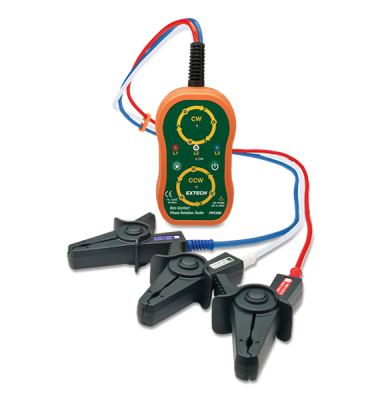
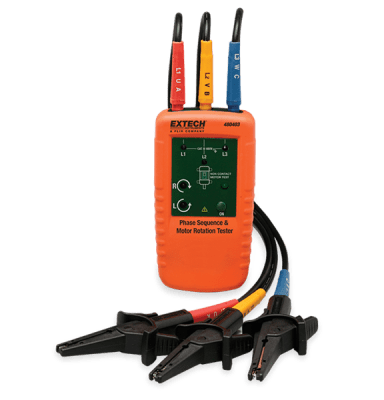
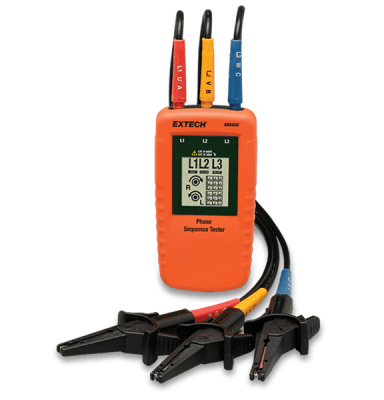
In a three-phase system, the order in which the phase voltages reach their positive peaks establishes phase sequence. Interchanging any two phases reverses the sequence and usually reverses the direction of a conventional three-phase induction motor. Equipment such as pumps and fans can be damaged or perform poorly if started in reverse.
A phase-sequence tester identifies the order at the supply so installers can maintain consistent phasing from source to load.
A motor-rotation function can help determine the expected shaft direction from the motor terminals before energizing the motor. The exact procedure varies by instrument and may require rotating the shaft manually. This can be useful when the motor is uncoupled or when an incorrect initial rotation would be hazardous.
Always follow the tester instructions and lockout/tagout requirements. Motor leads can retain or receive dangerous voltage from connected equipment if isolation is incomplete.
Verify that the tester covers the line-to-line voltage of the system. Industrial installations commonly involve 208, 240, 480 or 600 V class equipment, but instrument limits differ. Safety category, lead rating and protective equipment should suit the measurement location.
Non-contact functions can reduce connection time, but they do not eliminate the need for safe work practices or voltage verification.
A practical sequence is to verify supply voltage, confirm phase presence, check phase sequence, confirm motor wiring, and then verify actual mechanical rotation during a controlled startup when safe to do so. Document the established phase order so replacement equipment can be connected consistently later.
Phase and motor rotation testers are widely used by electricians, HVAC technicians, industrial maintenance teams, pump installers, elevator technicians and OEM service personnel. They are especially valuable after utility work, transformer replacement, switchgear changes or relocating equipment because phase order can change even when measured voltages are correct.
For a faster and more accurate selection, confirm the following application details before comparing part numbers:
Phase rotation testers verify electrical sequence; they do not measure motor mechanical condition. Vibration, current and insulation tests address different maintenance questions and should be selected separately.
No. Three-phase voltages can be correct while phase sequence is reversed.
For a conventional motor, interchanging any two supply phases generally reverses rotation, subject to the equipment manufacturer wiring instructions.
Only if the tester manufacturer specifically permits it; PWM drive output is different from normal utility sine-wave power.