
Laser distance meters replace many routine tape measurements with a fast optical measurement from the instrument to a target. They are useful for room dimensions, equipment layouts, cable runs, mounting heights, warehouse planning and estimating work where one-person measurement improves efficiency.
Important specifications include maximum range, stated accuracy, minimum range, indoor/outdoor visibility, reference-point selection, indirect measurement functions, environmental rating and whether Bluetooth or data transfer is needed.


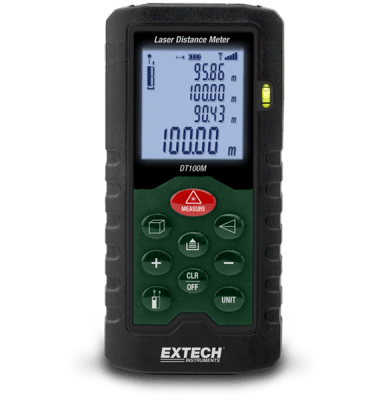
The meter emits a laser beam toward a target and calculates distance from the returned light. For reliable results, the target must reflect enough light back to the receiver. Dark, highly absorptive, transparent or highly reflective surfaces can reduce range or create unstable readings.
Outdoor sunlight can make the laser spot difficult to see and can reduce effective range. Models intended for longer outdoor work may support a camera viewfinder or target plate.
A long advertised range is not automatically useful if the environment rarely provides a good target. Compare accuracy specifications over the distances you expect to measure. For layout work, a few millimeters may be acceptable; precision fabrication may require a different measurement method entirely.
Many meters allow measurement from the front or rear edge of the housing. Confirm the selected reference point before recording dimensions.
Most meters can calculate area and volume from sequential measurements. Pythagorean modes estimate inaccessible heights or distances by measuring from a fixed location, but indirect calculations magnify positioning error. A tripod or steady reference improves results when accuracy matters.
Continuous measurement can be useful when locating a specified setback or clearance because the display updates as the meter moves.
Applications include sizing rooms, locating equipment, estimating conduit and cable runs, measuring ceiling heights, planning racks and cabinets, checking clearances and documenting as-built spaces. Laser meters are especially helpful where a tape would sag, require a second person or be difficult to anchor.
A laser distance meter does not replace a tape, caliper or survey instrument for every task. Obstructions, glass, moving targets and poor reflectivity can cause errors. Follow the laser safety classification on the instrument and avoid deliberately directing the beam toward eyes or traffic.
For a faster and more accurate selection, confirm the following application details before comparing part numbers:
Laser distance meters measure geometric distance to a target. They should not be confused with laser thermometers, which use a laser only for aiming while measuring infrared surface temperature.
Measurements through transparent surfaces can be unreliable because the beam may reflect from the glass itself or another surface.
Yes if the model has adequate range and visibility, but bright sunlight can reduce effective performance.
It is the physical point on the meter—often front or rear—from which the displayed distance is calculated.