
Infrared thermometers measure surface temperature from a distance by detecting emitted infrared energy. They are useful for quickly scanning electrical connections, motors, bearings, ducts, process equipment and other surfaces that are hot, moving or inconvenient to contact.
Correct use depends on distance-to-spot ratio, emissivity, temperature range, spectral response and the target surface. The laser is an aiming aid only; it does not perform the temperature measurement.


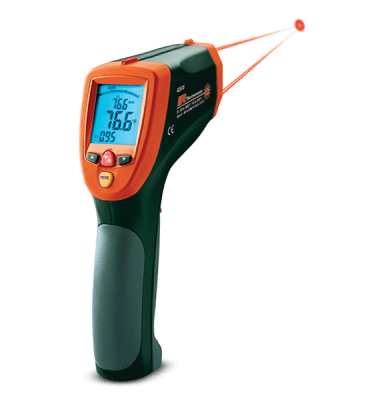

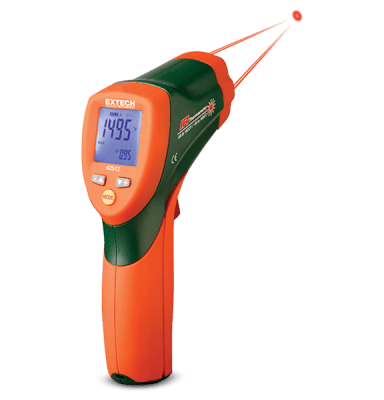
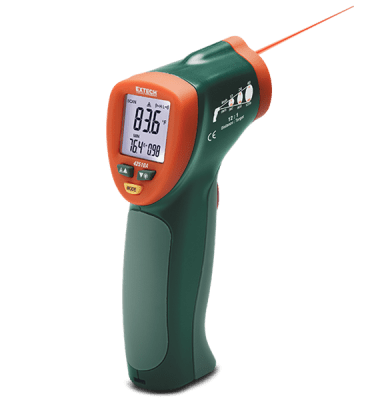

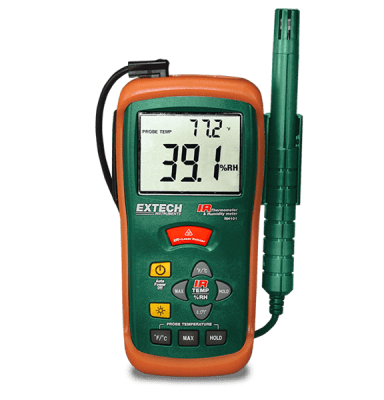

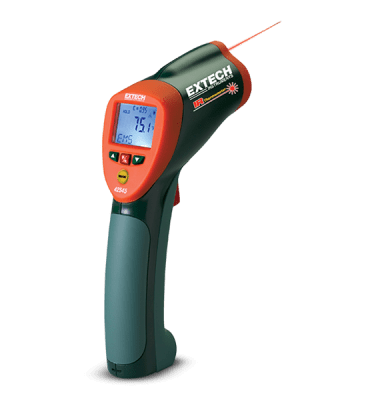
The distance-to-spot ratio describes how large an area the thermometer averages at a given distance. A 12:1 instrument, for example, measures a spot that grows as the operator moves farther away. For meaningful results, the target should be larger than the measurement spot, preferably by a comfortable margin.
Small electrical terminals and narrow pipes often require close measurement or a higher optical ratio. Measuring from too far away can blend the target with surrounding surfaces.
Emissivity describes how effectively a surface emits infrared energy. Painted, oxidized and nonmetallic surfaces often have relatively high emissivity, while shiny bare metals can have low emissivity and reflect surrounding infrared energy. Adjustable-emissivity thermometers are useful when working with varied surfaces.
Apparent temperature errors on reflective metal can be large. Where accuracy is important, use a known emissivity method, surface treatment or contact probe appropriate to the procedure.
Standard IR thermometers generally cannot measure accurately through ordinary glass because the glass has its own infrared transmission and temperature characteristics. Steam, smoke, dust and dirty optics can also interfere with the optical path.
For electrical panels with infrared inspection windows, verify compatibility between the window material and the instrument spectral band.
Technicians use IR thermometers to compare similar electrical connections, check supply/return air temperatures, locate hot bearings, monitor process surfaces, check refrigeration components and find abnormal heating. Comparative readings are often more useful than a single absolute temperature, especially when similar components operate under similar loads.
An IR thermometer reports an average temperature for one spot. A thermal imager creates a temperature map across many pixels, making it much faster to locate an unknown hot or cold area. Use an IR thermometer when the target is known and point measurement is sufficient; use thermal imaging when spatial patterns matter.
For a faster and more accurate selection, confirm the following application details before comparing part numbers:
Infrared thermometers provide a single spot measurement. Thermal imagers are the better tool when the location of the hot or cold area is unknown or when a temperature pattern across a surface is needed.
No. The laser only indicates the approximate aim point; the infrared detector measures thermal radiation.
Low-emissivity surfaces reflect surrounding infrared energy, which can distort the apparent temperature.
Usually not with a standard IR thermometer; the instrument typically reads the glass rather than the object behind it.