• Questions? Call 570-823-6181

You are here: Home > Product Categories > Power Conversion & Protection > Power Conditioners > Hardwired Power Conditioners

Hardwired Power Conditioners

Hardwired Power Conditioners

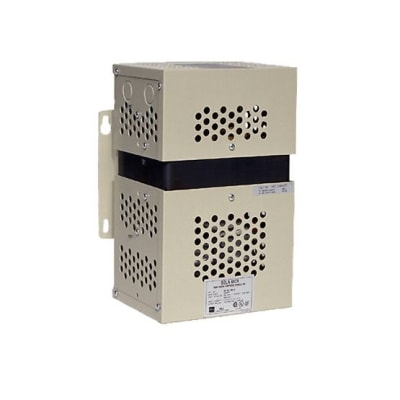
Shop hardwired power conditioners designed for permanent installation with industrial, commercial and electronic equipment. Depending on the design, these units may provide voltage regulation, electrical isolation, noise attenuation and protection from selected disturbances on the incoming power line.

Compare hardwired power conditioners by input and output voltage, phase, VA or kVA capacity, regulation range, frequency, enclosure and installation requirements. Identify the connected load and the specific power-quality problem before selecting a conditioner.

Filters

Filters

Sort By:
Products per page

Phase

Three Phase (16)

Power Rating

1.1–3 kVA (10)
3.1–10 kVA (10)
10.1–50 kVA (15)
50.1–250 kVA (4)
101–500 VA (7)
501 VA–1 kVA (5)

Manufacturer

SolaHD (51)

Power Rating (VA / kVA)

Under 500 VA (4)
500 VA – 999 VA (4)
1 – 2.99 kVA (10)
3 – 9.99 kVA (11)
10 – 29.99 kVA (10)
30 – 74.99 kVA (8)
75 – 149.99 kVA (4)

Phase

Three-Phase (16)

Input Voltage

208 VAC (4)
460 / 480 VAC (8)
575 / 600 VAC (4)

Output Voltage

208 VAC (12)

How to Select a Hardwired Power Conditioner

Hardwired power conditioners are installed directly into an electrical system and are commonly used where sensitive equipment requires more stable or cleaner incoming power. Depending on the product design, conditioning functions may include voltage regulation, isolation, noise attenuation and protection against selected transient disturbances.

The first step is identifying the actual power-quality problem. Sustained undervoltage, overvoltage, electrical noise, transient activity and complete outages require different solutions. A power conditioner should be selected for the specific disturbance and connected load rather than simply by matching voltage.

Important Selection Factors

  • Input voltage: Match the available electrical source and expected operating range.
  • Output voltage: Confirm the voltage required by the connected equipment.
  • Load capacity: Size the conditioner for the continuous VA or kVA requirement.
  • Inrush demand: Account for temporary startup current from transformers, motors and electronic loads.
  • Phase: Verify single-phase or three-phase system requirements.
  • Voltage regulation: Review allowable input variation and regulated output performance.
  • Isolation: Determine whether electrical isolation between source and load is required.
  • Frequency: Confirm compatibility with the available electrical supply.
  • Enclosure and installation: Verify wiring, mounting, ventilation and environmental requirements.

Hardwired vs. Portable Power Conditioners

Hardwired conditioners become part of the permanent electrical installation and are commonly selected for machinery, control systems and dedicated equipment circuits. Portable units use cord-and-plug connections and can be moved or replaced without modifying permanent wiring.

Replacement Checklist

  • Manufacturer and complete conditioner model number
  • Input and output voltage
  • Single-phase or three-phase system
  • VA or kVA rating
  • Connected load and startup requirements
  • Frequency
  • Required regulation or isolation function
  • Enclosure and mounting requirements
  • Photographs of the existing nameplate and wiring connections
Need help identifying a hardwired power conditioner?
Email [email protected] with the manufacturer, complete model number, input and output voltage, load rating, phase and photographs of the existing equipment.
Empty Cart