
Shop Ethernet and PoE extenders for carrying network connections beyond conventional copper Ethernet distances or across compatible existing cabling. Wallco offers network-extension solutions for commercial, industrial, security and communications applications.
Compare extenders by supported network speed, transmission medium, distance, PoE capability and installation requirements. Select equipment that matches the cabling and network interfaces at both ends of the connection.
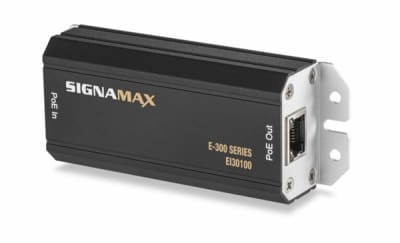


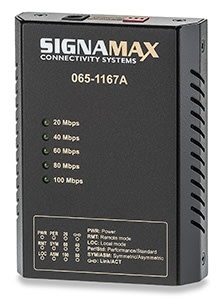


Ethernet extenders provide solutions for network links that need to reach beyond the practical distance of a conventional copper Ethernet connection or operate across an existing cabling medium that cannot be replaced easily.
Depending on the extender system, Ethernet communications may be carried over twisted-pair cabling, coaxial cable or another supported transmission medium. Some systems may also support Power over Ethernet for compatible remote devices.
An Ethernet extender can be useful when a network device is located farther from the switch than a normal copper Ethernet link can practically support, or when existing cabling needs to be reused as part of an infrastructure upgrade.
Typical situations can include connecting remote cameras, building systems, access-control equipment, industrial devices or other Ethernet-enabled equipment without installing an entirely new network pathway.
Existing coaxial infrastructure may sometimes be reused for Ethernet communications through compatible extender equipment. This can be particularly useful in retrofit projects where replacing existing cable would be difficult or disruptive.
The condition, type and topology of the existing coaxial cable should be evaluated before selecting an extender. Supported distance and network performance depend on the specific extender system and installation.
Ethernet extension over compatible twisted-pair infrastructure can provide another option for reaching remote equipment where conventional Ethernet-distance limits would otherwise require a different network design.
Do not assume that any existing copper pair can support a particular extender system. Verify the required cable construction, pair count and distance against the specifications of the equipment.
Power over Ethernet can simplify remote-device installations by carrying network communications and electrical power through the network connection. When an extender supports PoE, it may provide a practical solution for compatible cameras, access points and other powered network devices located beyond conventional Ethernet distances.
PoE compatibility and available power should be checked carefully. Confirm the requirements of the remote device and the capabilities of the extender and upstream network equipment before installation.
Ethernet extenders and fiber media converters can both solve network-distance problems, but they address different infrastructure situations.
A media converter is commonly used when the network can transition from copper Ethernet to fiber optic cabling. An Ethernet extender may be more appropriate when an existing twisted-pair or coaxial pathway needs to be reused.
The best approach depends on the available cabling, required distance, network speed, installation environment and future infrastructure plans.
Ethernet extenders may be used in applications including:
Ethernet extension depends heavily on the physical cable between the two endpoints. Before selecting equipment, identify the cable type, cable distance, network speed and remote-device requirements.
If PoE is required, include the powered-device requirements in the selection process. For retrofit projects, verify the condition and configuration of existing cabling rather than assuming that an extender will work over every available cable path.

