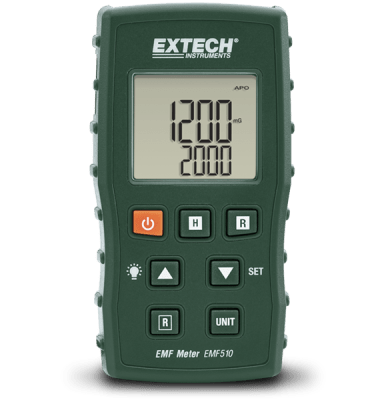
EMF and magnetic field meters measure field strength around energized wiring, transformers, motors, appliances, power-distribution equipment and other electrical sources. They are used for troubleshooting, comparative surveys, equipment evaluation and documenting field levels in a defined frequency range.
The correct instrument depends on whether the target is a low-frequency magnetic field, electric field, radio-frequency field or a specialized DC magnetic measurement. Frequency response, axis configuration, units and measurement range must match the application.
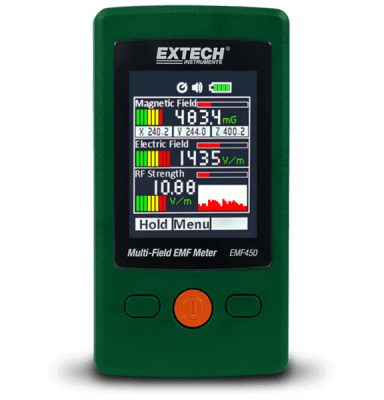


The term EMF is broad. Power-frequency magnetic fields are typically associated with 50/60 Hz current flow and are often displayed in gauss, milligauss, tesla or microtesla. Electric fields are measured differently, and RF electromagnetic fields from transmitters, wireless systems or microwave sources require instruments designed for much higher frequencies.
A low-frequency magnetic field meter should not be assumed to measure RF exposure, and an RF survey meter may not be appropriate for power-frequency troubleshooting.
A single-axis sensor measures the field component aligned with the sensing axis, so orientation has a strong effect on the reading. Three-axis meters combine measurements in three perpendicular directions and can simplify surveys where the field direction is unknown or changing.
For repeatable comparisons, document the sensor orientation, location and distance from the source. Magnetic field strength can change dramatically over short distances.
Select a range that covers both expected background levels and stronger fields near the equipment. High resolution is useful for comparative surveys, but accuracy and frequency response are more important than the number of displayed digits.
Power systems may contain harmonics, variable-frequency drive output and switching components. If these are relevant, verify that the meter frequency bandwidth includes them.
Applications include checking field levels around transformers, switchgear, busways, motors, welders, VFD-fed equipment and cable routes; comparing before-and-after wiring changes; locating field sources; and documenting conditions during facility surveys.
Measurements should be interpreted in context. A field reading alone does not establish equipment safety, regulatory compliance or health risk unless it is compared with the appropriate standard and measurement method.
Keep the meter away from metal objects or electronics that may affect the sensor unless those objects are part of the test condition. Repeat measurements at defined distances and heights. For troubleshooting, compare similar equipment under similar load because magnetic fields generally increase with current.
For a faster and more accurate selection, confirm the following application details before comparing part numbers:
Low-frequency magnetic-field meters, RF field-strength meters and DC gaussmeters are different instrument classes. Match the sensor bandwidth to the source instead of relying on the broad term EMF meter.
Only if it is specifically designed for the relevant RF frequency range. Many magnetic field meters measure only low-frequency fields.
They are units of magnetic flux density; 1 tesla equals 10,000 gauss.
Single-axis sensors are directional. A three-axis meter reduces orientation dependence by measuring three perpendicular components.