
Access control systems manage who can enter controlled doors, gates and secured areas by coordinating credentials, readers, controllers, locking hardware and management software. A complete design must consider life safety, door hardware, power, network architecture and the level of auditability required—not simply the reader technology at the wall.
Define each opening and security objective, then select credential technology, reader interface, controller architecture, lock type, door-position and request-to-exit devices, power supply and software platform. Fire/life-safety and egress requirements must be incorporated into the door design.



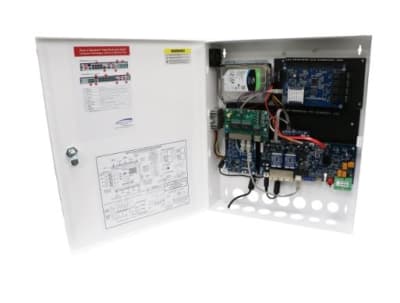
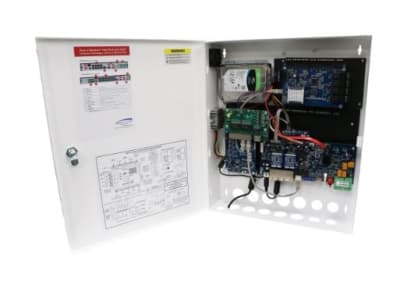

A user presents a credential to a reader. The reader passes credential data to a controller, which applies programmed rules and signals the locking hardware. Door contacts and request-to-exit devices provide additional state information so the system can distinguish valid entry from forced or propped doors.
Common credential forms include proximity cards, smart cards, key fobs, mobile credentials and biometric methods. Higher-security smart credentials can support stronger authentication than older low-frequency proximity formats. Reader and credential technology must match.
Controllers may support one, two or many doors and can be centrally networked or distributed near the openings. Consider offline behavior, event storage, network resilience, input/output capacity and expansion. The access-control database and software determine how permissions and schedules are managed.
Legacy readers commonly use Wiegand wiring, while OSDP provides a bidirectional RS-485-based approach with supervision and optional secure channel on supported devices. For new systems, interface selection can affect security, diagnostics and future flexibility.
Electric strikes, magnetic locks and electrified hardware behave differently during power loss and fire alarm conditions. Door operation must satisfy applicable building, fire and accessibility rules. Access control should never be designed independently of the door hardware and egress requirements.
Controllers, readers and locks may require separate or shared low-voltage power. Lock current, battery backup duration, fire-alarm interfaces and voltage drop need to be calculated. Critical sites may also require monitored power supplies and supervised circuits.
Network-connected access control should use supported software, strong administrator authentication, segmented networks and controlled remote access. Credential issuance, revocation and audit procedures are part of security; hardware alone cannot compensate for weak administration.
Applications range from single office doors and server rooms to multi-building campuses, gates, elevators and high-security areas. Each opening should be treated as a small system with a reader, lock, door position, egress method and power-fail behavior. A warehouse gate may require vehicle credentials and long-range readers, while an interior office may use a simple smart-card reader and electric strike.
Older systems may use low-frequency proximity cards that are convenient but provide limited security against cloning. Organizations planning upgrades should decide whether to maintain legacy credentials temporarily, move to secure smart credentials or adopt mobile credentials. Reader technology, controller interfaces and enrollment process should support the chosen migration path without forcing all doors to change at once.
Access control design must be coordinated with the physical door assembly. Electric strikes, electrified mortise locks, panic hardware, magnetic locks and gate operators have different wiring, current draw and fail-safe/fail-secure behavior. Door position switches, request-to-exit devices and latch monitoring can improve event accuracy. Before ordering electronics, confirm the door, frame, fire rating, handing, existing hardware and who is responsible for modifications so the access-control components do not conflict with life-safety or architectural requirements.
For a replacement or new installation, send Wallco the equipment model, system type, electrical or network requirements, installation environment and any compatibility constraints. The more application detail provided, the easier it is to narrow the correct product family and avoid a physically similar but incompatible part.
