
Access control system kits package multiple components needed to build or expand a controlled-door system. Depending on the kit, this can include a controller, reader, credentials, power components, enclosure, software interface or other matched hardware. Kits are useful when a buyer wants a coordinated starting point rather than sourcing every component separately.
A kit should still be evaluated as a system, not as a simple box of parts. Door hardware, locking method, life-safety requirements, credential technology, network connection, power, backup runtime and software licensing may fall outside the kit or vary by application.

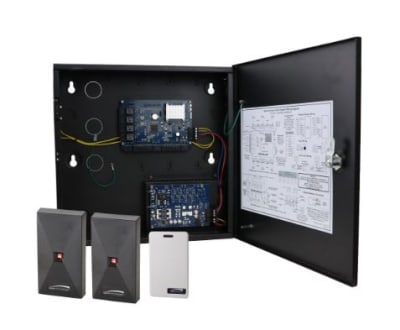

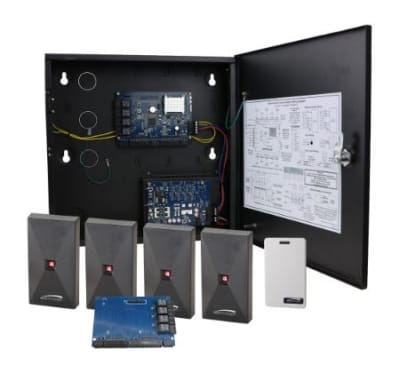

Contents vary significantly. Some kits are intended for a single opening and include a compact controller and reader, while others provide expandable multi-door control. Credentials, request-to-exit devices, door contacts, electric strikes, magnetic locks, power supplies and batteries may or may not be included. Review the bill of materials rather than assuming every item shown in a typical diagram is part of the package.
The access control electronics must work with the physical opening. Electric strikes, magnetic locks and electrified hardware have different power, fail-safe/fail-secure and installation requirements. Fire and egress codes can affect how locks are released. Determine the door type, existing mechanical hardware and required behavior during power loss before treating a kit as complete.
Confirm the included or supported reader technology and which credential formats can be enrolled. If the site already has badges, the new kit should be evaluated for compatibility with those credentials. For a new facility, consider whether the chosen credential technology can scale to future doors without forcing a system-wide replacement.
A kit sized for one or two doors may be ideal for a standalone office but restrictive for a growing facility. Review door capacity, input/output points, network architecture, software limits and expansion options. A slightly larger controller platform can be worthwhile when additional controlled openings are likely.
Access control systems may need to power controllers, readers and locking hardware continuously. Determine total current, voltage, wire distance and desired battery runtime. Locking devices can represent a substantial portion of the load. Backup batteries and supervised power supplies may be separate from the kit and should be sized as part of the complete system.
Modern systems may use local software, browser interfaces or hosted services. Verify licensing, supported operating systems, network requirements, remote management capabilities and any recurring service obligations. A hardware kit can be attractive on price but still be a poor fit if the management platform conflicts with the customer’s IT requirements.
Define the number of doors, credential technology, lock type, network environment, backup requirement and expansion plans first. Then compare kit contents to the complete project bill of materials. Kits work best when they simplify a properly defined system—not when they are used to avoid defining the system.
A one-door kit is not necessarily a complete door installation. Cabling, locking hardware, request-to-exit devices and door contacts may be separate. Multi-door capacity refers to controller capability, but software licensing can impose additional limits. Always verify what is included and what must be purchased separately.
Wallco can help compare specifications, compatibility and application requirements when you are selecting new components or replacing an existing part. Providing the manufacturer and model of the equipment you are connecting to, along with key electrical, mechanical and environmental requirements, helps narrow the correct choice.
