
DC power cables carry low-voltage or intermediate-voltage direct current between power supplies, batteries, converters and electronic loads. Applications range from controls and communications equipment to LED systems, vehicle electronics, instrumentation and industrial devices. Voltage, continuous current, allowable voltage drop, connector polarity, conductor gauge, fuse protection and environmental exposure are central to safe cable selection.
DC loads can be especially sensitive to conductor resistance because low system voltage leaves less margin for drop. The voltage lost in a cable is proportional to current and total circuit resistance, which includes both the outgoing and return conductors. Long runs or high current therefore require larger conductors than a short low-current lead.
When sizing a cable, evaluate the load’s minimum operating voltage as well as conductor ampacity. A cable can remain thermally safe yet still cause equipment resets or poor performance because too much voltage is lost along the run.
Select conductor size for continuous current, allowable temperature rise, length and installation method. Bundled cables, high ambient temperature and enclosed pathways can reduce cooling. Flexible stranded conductors are common in equipment leads, while fixed installations may use constructions suited to trays, conduit or building wiring.
Do not assume a connector’s advertised current rating means any cable attached to it can carry the same current. The complete assembly is limited by its smallest conductor, weakest contact and environmental rating.
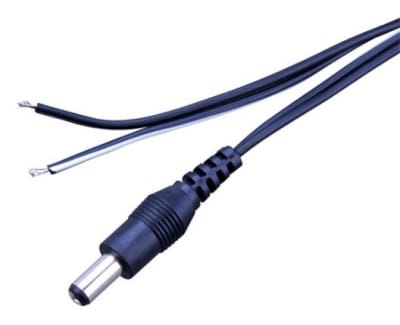
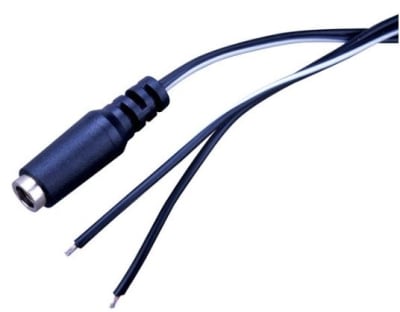
DC connectors include barrel plugs, locking coaxial connectors, Anderson-style connectors, ring terminals, spade terminals, terminal blocks, automotive connectors and many proprietary formats. Barrel connectors may be center-positive or center-negative, so physical fit does not guarantee electrical compatibility.
Before connecting an unfamiliar cable, verify polarity, pinout and voltage with equipment documentation or appropriate test methods. Reversed polarity can damage devices that lack reverse-polarity protection.
DC circuits supplied by batteries can deliver very high fault current. Proper overcurrent protection should be located and sized according to the power source, conductor ampacity and equipment requirements. A fuse protects wiring from excessive current; it is not a substitute for selecting the correct conductor size.
Vehicle, marine and battery systems deserve particular attention because long unfused leads can present significant fire risk if insulation is damaged or a conductor shorts to chassis.
Robotics, machinery and mobile equipment may require high-flex conductors, oil-resistant jackets, abrasion resistance and secure connectors. Outdoor systems may require UV, moisture and temperature resistance. Standard indoor zip cord or consumer adapter leads may not survive those conditions.
For sensor and control circuits, electrical noise can also matter. Twisted pairs or shielding may be appropriate when low-level signals share routing with DC power, though power and signal functions should be separated according to the system design.
Document nominal voltage, maximum continuous current, startup/inrush current if significant, cable length, connector on both ends, polarity, wire gauge and environment. If the cable is part of a listed power supply or battery assembly, replacement with the manufacturer-specified cord may be preferable to a generic substitute.
For custom assemblies, verify crimp quality, strain relief and contact material. High-resistance terminations can overheat even when the conductor itself is adequately sized.
For a DC cable or custom assembly, record nominal and maximum voltage, continuous and startup current, one-way run length, allowable voltage drop, conductor gauge, connector/pinout, polarity and environment. If the source is a battery, identify source-side fuse or breaker requirements. For sensitive electronics, measure voltage at the load under operating current rather than only at the supply; a cable can appear correct at no load while excessive resistance causes the device voltage to collapse during operation.
Use current, total circuit length, allowable voltage drop, temperature and installation conditions—not current alone.
No. Both center-positive and center-negative wiring exist; verify polarity before connection.
A battery can supply very high fault current, so source-side overcurrent protection helps protect the downstream wiring from a short circuit.
Wallco can help match connector type, electrical or optical requirements, cable length and installation conditions to the application. When possible, provide the equipment manufacturer/model, existing connector information and required run length.

