
Phone-style audio connectors appear in both compact 3.5 mm and larger 1/4-inch sizes. They can carry mono, stereo, balanced or unbalanced signals depending on the number of contacts and the equipment wiring. That means connector diameter alone is not enough to select the correct cable.
TS connectors have tip and sleeve contacts, while TRS adds a ring. In different applications, TRS may represent stereo left/right audio or a balanced mono connection. Some 3.5 mm connectors add additional contacts for microphones or controls, making exact equipment compatibility important.
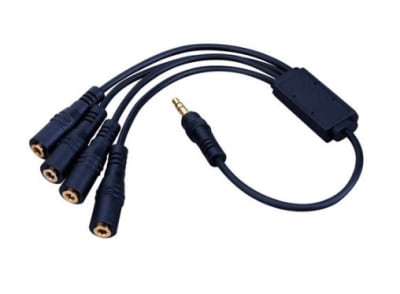




TS cables are commonly used for unbalanced mono signals such as many electric instruments. TRS can carry either stereo unbalanced audio or balanced mono audio depending on the connected equipment. Never assume TRS automatically means stereo or automatically means balanced; check the jack labeling or equipment manual.
3.5 mm connections are common on computers, portable devices, small mixers, powered speakers and legacy consumer electronics. Three-contact TRS plugs are often used for stereo audio, while four-contact TRRS formats can combine headphones and microphone functions with device-specific wiring conventions.
Quarter-inch TS connectors are widespread for instruments and unbalanced line connections. Quarter-inch TRS connectors are common for balanced line-level connections, insert cables and stereo headphone outputs. Insert wiring can use one TRS connector split to two separate plugs, which is electrically different from a normal stereo patch cable.
Instrument-level and other high-impedance unbalanced signals can be sensitive to cable capacitance and noise, so overly long runs may reduce high-frequency response or pick up interference. Balanced TRS line-level connections are better suited to longer professional runs when the equipment supports them.
Confirm connector size, number of contacts, signal role and gender at both ends. Determine whether the circuit is stereo, balanced mono, unbalanced mono, headset or insert. This prevents one of the most common audio-cabling mistakes: buying a cable that fits physically but routes the contacts incorrectly.
Audio adapters can change connector size without changing the underlying signal. A 3.5 mm-to-1/4-inch adapter may be appropriate when both devices use the same stereo or mono topology, but it cannot create a balanced output from an unbalanced source. Y-cables and insert cables also use familiar connectors in specialized wiring arrangements, so their purpose should be confirmed before substitution.
Before ordering 3.5mm & 1/4-inch audio cables, record the equipment interfaces at both ends, the required electrical or signal standard, cable length, installation environment and any existing part number or cable marking. For replacements, matching only the connector can be misleading; confirm the underlying signal type, impedance, conductor configuration, performance rating and environmental requirements. Providing those details helps Wallco narrow the correct product and avoid compatibility problems.
Cable performance is a system issue: the source, destination, connectors, cable construction, length and installation conditions all contribute to the result. A cable that physically fits is not automatically electrically compatible, and a higher advertised category or bandwidth does not correct a mismatched interface. When in doubt, start with the equipment manufacturer specifications and choose a cable assembly or bulk cable that explicitly supports those requirements.
Wallco can help compare cable construction, connectors, ratings and application requirements when you are selecting a new installation product or replacing an existing cable. If available, provide the connected equipment models, existing cable markings, required length and installation environment so the options can be narrowed accurately.