
Network cable assemblies provide ready-to-use copper Ethernet links between switches, patch panels, computers, access points, cameras, phones and other network devices. Factory termination offers consistent connector installation and makes patching faster than field-terminating short equipment cords.
Category, shielding, conductor type, jacket, connector construction, length and PoE requirements should match the network design. Cat5e, Cat6 and Cat6A patch cables support different performance margins and installation goals, while shielded systems require compatible grounded components throughout the channel.
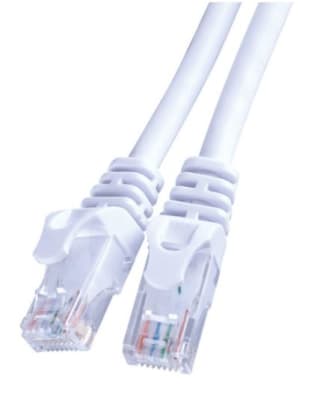
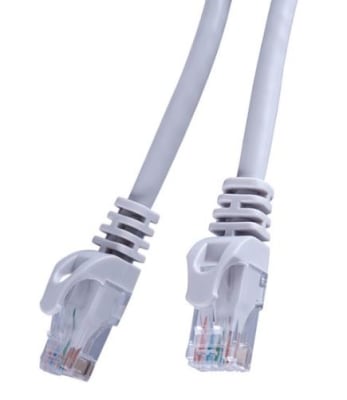
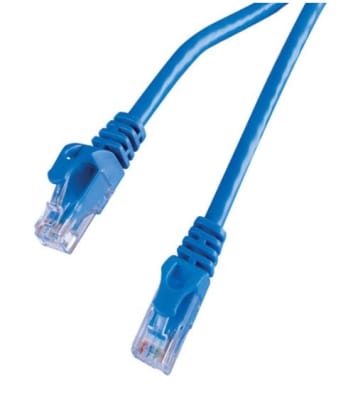
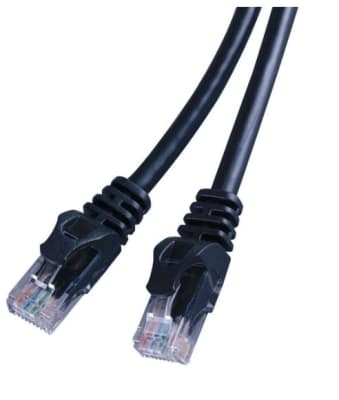
Category selection should be based on the required Ethernet speed, link design and installed structured cabling. Cat6 provides improved crosstalk performance over Cat5e, while Cat6A is commonly selected for 10 Gigabit Ethernet channels and stronger alien-crosstalk control. The entire channel—not just the patch cord—must support the intended category performance.
Patch cables commonly use stranded conductors because they are flexible and tolerate repeated moves better than horizontal solid-conductor cable. That flexibility comes with somewhat higher insertion loss, which is one reason structured-cabling standards limit patch-cord lengths within a channel.
UTP works well in many offices and data environments. Shielded patch cables can be useful where the installed system is shielded or electromagnetic noise is a concern, but shielding should be continuous through jacks, panels and grounding architecture. Adding one shielded cord to an otherwise unshielded channel does not create a properly shielded system.
Power over Ethernet places DC current on twisted pairs while data is transmitted. Conductor size, connector quality, bundle size and temperature can matter in high-power PoE installations. Use assemblies rated for the intended application and avoid unnecessary tightly packed bundles in hot environments.
Match the cord category to the permanent link, choose the shortest practical length, verify connector style and boot clearance, and determine whether snagless, slim, shielded or special-jacket versions are needed. For new 10G installations, evaluate the complete Cat6A channel rather than upgrading only the patch cords.
Network assemblies are one part of a complete structured-cabling channel that can also include horizontal cable, jacks, patch panels and consolidation points. Channel performance is limited by the weakest component and by installation workmanship. Matching Category ratings across the system and maintaining pair twist at terminations is more meaningful than buying an isolated high-category patch cord for a lower-category permanent link.
Before ordering network cable assemblies, record the equipment interfaces at both ends, the required electrical or signal standard, cable length, installation environment and any existing part number or cable marking. For replacements, matching only the connector can be misleading; confirm the underlying signal type, impedance, conductor configuration, performance rating and environmental requirements. Providing those details helps Wallco narrow the correct product and avoid compatibility problems.
Cable performance is a system issue: the source, destination, connectors, cable construction, length and installation conditions all contribute to the result. A cable that physically fits is not automatically electrically compatible, and a higher advertised category or bandwidth does not correct a mismatched interface. When in doubt, start with the equipment manufacturer specifications and choose a cable assembly or bulk cable that explicitly supports those requirements.
Wallco can help compare cable construction, connectors, ratings and application requirements when you are selecting a new installation product or replacing an existing cable. If available, provide the connected equipment models, existing cable markings, required length and installation environment so the options can be narrowed accurately.