
In-wall and in-ceiling speakers provide permanent audio while keeping cabinets and wiring largely out of sight. They are used for distributed music, home theater surround channels, conference spaces, hospitality, retail and other installations where appearance and floor space matter.
Good selection requires matching speaker type, impedance or transformer configuration, coverage pattern, power handling, sensitivity, back-box requirements, cutout dimensions and the room construction. Placement and amplification have as much effect on the result as the speaker model itself.


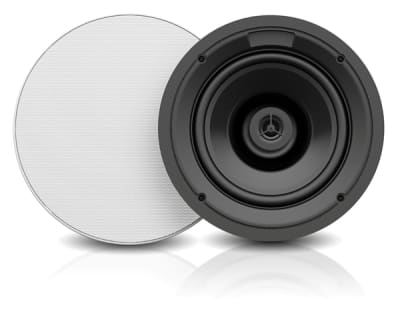
In-ceiling speakers are well suited to distributed background audio and rooms where wall space is limited. In-wall speakers can place drivers closer to ear height and may be preferred for front left/right or theater channels. Angled baffles or pivoting tweeters can help direct sound toward the listening area.
For stereo music, maintain reasonable left/right separation and symmetry. For distributed coverage, use more speakers at lower level rather than forcing a few speakers to cover an overly large area.
Many residential architectural speakers are low-impedance designs used with conventional amplifiers. Commercial distributed systems may use built-in or external 70 V/100 V transformers, allowing many speakers to share a line and simplifying long cable runs.
Do not mix system types without proper design. Amplifier output format, speaker taps and total connected wattage must be compatible.
Power rating alone does not determine loudness. Sensitivity, listening distance, room acoustics and amplifier capability all matter. Wide-dispersion ceiling speakers can provide even background coverage, while directional designs concentrate energy in a smaller area.
For commercial systems, calculate speaker spacing and transformer tap settings so the amplifier has appropriate headroom.
Verify cutout diameter or dimensions, mounting depth and clearance from joists, ducts, pipes and electrical wiring. Some installations require fire-rated back cans, plenum considerations or listed assemblies. Moisture-resistant models may be needed for bathrooms, covered outdoor spaces or humid environments.
Use speaker cable suitable for the installation location and local code requirements.
Open wall and ceiling cavities affect bass response and can allow sound transmission into adjacent rooms. Back boxes can improve consistency, limit sound leakage and protect the speaker. Room surfaces also influence intelligibility and tonal balance; hard reflective spaces may need different coverage or equalization than furnished rooms.
For a faster and more accurate selection, confirm the following application details before comparing part numbers:
Architectural speakers are installed into the building surface. Surface-mount and portable speakers use different hardware and acoustic assumptions, so installation method should be decided early in the audio design.
Only if impedance or transformer configuration and power requirements match the amplifier.
Not always, but back boxes can improve consistency, control sound leakage and satisfy certain installation requirements.
It depends on coverage angle, ceiling height, desired sound level and room layout rather than square footage alone.