
F-type connectors are widely used on 75-ohm coaxial systems because they provide a simple threaded connection and use the cable center conductor as the mating pin. They are common on televisions, cable modems, splitters, satellite receivers, antennas and broadband distribution equipment.
Performance depends on the underlying coax type, connector termination, shielding and frequency range. RG6-style constructions are common for modern broadband and satellite distribution, while other coax sizes may be used in shorter legacy or specialty applications.
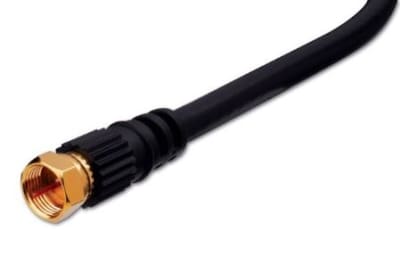


F-type systems are normally designed around 75-ohm impedance. Keeping cable, splitters, amplifiers and terminations consistent helps minimize reflections and maintain predictable signal levels. Do not confuse F-type coax with 50-ohm RF assemblies used for many radio and test applications.
RG6-type coax is widely used for broadband, satellite and television because it typically offers lower loss than smaller RG59-type cable at higher frequencies. Actual performance depends on the manufacturer construction, dielectric, shielding and conductor, so the RG designation alone does not tell the whole story.
Foil and braid combinations help prevent external interference from entering the cable and reduce signal leakage. Poor connector installation can compromise shielding and allow moisture or RF ingress. Outdoor connections should use appropriately weather-sealed components and drip-loop practices where required.
Every foot of coax and every splitter adds loss. Higher frequencies generally experience more cable attenuation, and multi-way splitters divide available signal power among outputs. Long runs or complex distribution systems may require level calculations or properly designed amplification rather than simply adding adapters.
Choose the correct coax construction, connector gender, length and indoor/outdoor rating. For cable-modem and satellite systems, avoid excessively long thin patch cords and poorly shielded assemblies. A mechanically tight connection is important, but overtightening can damage equipment jacks.
An F-type patch cable normally operates as part of a system containing wall plates, splitters, taps, amplifiers, ground blocks or modems. Each component contributes insertion loss and frequency limits. Good troubleshooting therefore checks signal level across the path, connector quality and splitter configuration rather than replacing the final jumper without evaluating the rest of the coax network.
Before ordering f-type coaxial cables, record the equipment interfaces at both ends, the required electrical or signal standard, cable length, installation environment and any existing part number or cable marking. For replacements, matching only the connector can be misleading; confirm the underlying signal type, impedance, conductor configuration, performance rating and environmental requirements. Providing those details helps Wallco narrow the correct product and avoid compatibility problems.
Cable performance is a system issue: the source, destination, connectors, cable construction, length and installation conditions all contribute to the result. A cable that physically fits is not automatically electrically compatible, and a higher advertised category or bandwidth does not correct a mismatched interface. When in doubt, start with the equipment manufacturer specifications and choose a cable assembly or bulk cable that explicitly supports those requirements.
Wallco can help compare cable construction, connectors, ratings and application requirements when you are selecting a new installation product or replacing an existing cable. If available, provide the connected equipment models, existing cable markings, required length and installation environment so the options can be narrowed accurately.
