
BNC cable assemblies use a bayonet-style connector that locks with a short twist, making them convenient for equipment that is connected and disconnected regularly. They appear in oscilloscopes, signal generators, RF systems, broadcast video, legacy CCTV and professional test environments.
BNC is a connector family, not a single electrical specification. Both 50-ohm and 75-ohm versions exist, and they should be matched to the system impedance. Cable loss, frequency rating, shielding, connector quality and length become increasingly important at higher frequencies.

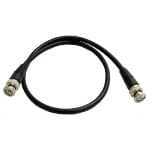
Fifty-ohm BNC assemblies are common for RF signals, antennas, laboratory instruments and test equipment. Maintaining 50-ohm impedance through cable and connectors helps control reflections and preserve measurement accuracy. High-frequency applications should be checked against the rated bandwidth of the complete assembly.
Seventy-five-ohm BNC is widely used for professional video and broadcast signals, including SDI families when the cable is designed for the required data rate. Although 50- and 75-ohm BNC connectors may look similar, their internal geometry differs and should not be mixed casually in precision links.
Small flexible coax is convenient for short patch leads, while larger low-loss coax is better for longer RF or video runs. Attenuation increases with frequency and distance. For SDI or other high-rate digital video, use cable specifically characterized for the required signal standard and length.
Oscilloscopes and signal generators often use BNC cables, but probe systems, 1x/10x attenuation and high-voltage measurement involve additional requirements beyond an ordinary coax patch lead. Do not substitute a generic BNC cable where a compensated or safety-rated probe is required.
Confirm 50 or 75 ohms, connector gender, cable length, frequency or video standard and environment. Right-angle connectors, flexible patch cable and low-loss types solve different mechanical problems. For replacements, matching the existing cable designation can help preserve system performance.
The BNC connector is used across RF, test, analog video and digital video systems. A 50-ohm oscilloscope cable and a 75-ohm SDI cable can both have BNC ends yet be optimized for different electrical environments. Treat the connector as one selection parameter among impedance, frequency, attenuation and cable construction rather than as the complete specification.
Before ordering bnc coaxial cables, record the equipment interfaces at both ends, the required electrical or signal standard, cable length, installation environment and any existing part number or cable marking. For replacements, matching only the connector can be misleading; confirm the underlying signal type, impedance, conductor configuration, performance rating and environmental requirements. Providing those details helps Wallco narrow the correct product and avoid compatibility problems.
Cable performance is a system issue: the source, destination, connectors, cable construction, length and installation conditions all contribute to the result. A cable that physically fits is not automatically electrically compatible, and a higher advertised category or bandwidth does not correct a mismatched interface. When in doubt, start with the equipment manufacturer specifications and choose a cable assembly or bulk cable that explicitly supports those requirements.
Wallco can help compare cable construction, connectors, ratings and application requirements when you are selecting a new installation product or replacing an existing cable. If available, provide the connected equipment models, existing cable markings, required length and installation environment so the options can be narrowed accurately.
