
Bench DC power supplies provide adjustable, regulated DC voltage for testing, troubleshooting and developing electronic circuits. Unlike fixed industrial power supplies, bench units are designed for frequent adjustment and typically display output voltage and current while providing controllable current limiting.
Choose a supply based on voltage and current range, total power, regulation, ripple/noise, channel count, series/parallel capability, current-limit behavior, output isolation and any remote programming or logging requirements.


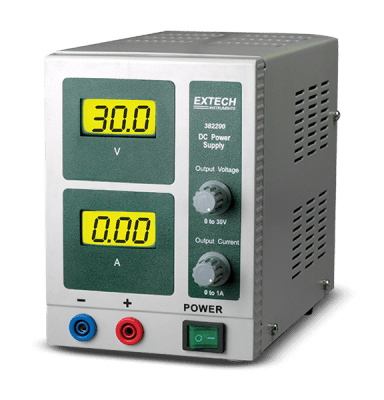

In constant-voltage mode, the supply regulates output voltage while the load draws the current it requires up to the current limit. If the load attempts to draw more than the set limit, the supply transitions into constant-current operation and reduces voltage as necessary to hold the programmed current.
Current limiting is valuable when powering an unknown or newly assembled circuit because it can reduce damage from shorts or wiring mistakes. Set a conservative current limit before connecting sensitive prototypes.
The maximum voltage and current cannot always be delivered simultaneously; total output wattage may impose an additional limit. Check the operating envelope rather than assuming a 60 V, 10 A supply can produce 600 W.
For loads with startup surge, motors or large capacitors, consider transient demand and the supply response. A bench supply intended for electronics may behave differently from a battery or industrial DC source during inrush.
Low ripple and noise matter when powering analog circuits, sensors, audio equipment and precision electronics. Line regulation describes output change as input mains varies, while load regulation describes output change as the connected load changes.
Switching bench supplies can offer high power in a compact package; linear supplies may be preferred for very low-noise work. Review the actual ripple specification rather than relying only on supply topology.
Dual- and triple-output supplies can power circuits requiring multiple rails. Independent isolated channels may be connected in series for higher voltage or configured as positive and negative rails when allowed by the manufacturer. Tracking modes simplify symmetrical adjustments.
Verify isolation limits and grounding arrangement before floating outputs or series-connecting channels. Output terminals may be isolated from chassis earth only within specified limits.
USB, LAN, RS-232 or programmable interfaces can automate testing and capture settings. Overvoltage, overcurrent and overtemperature protection are useful safeguards. Use appropriately rated leads and observe output polarity; a low-voltage bench supply can still deliver enough current to overheat wiring or components.
For a faster and more accurate selection, confirm the following application details before comparing part numbers:
Bench supplies are intended for adjustable laboratory and service work. Fixed DIN-rail power supplies are generally better for permanent control-panel installations where the voltage is not routinely adjusted.
Constant-current mode means the supply is limiting current and allowing voltage to fall as needed to maintain that limit.
Only if the outputs are suitably isolated and the manufacturer permits series operation.
Choose enough continuous current for the load plus reasonable margin, while also checking total wattage and startup behavior.